
Your CRM Isn’t Broken—Your ICP Is
I’ve heard that my CRM is a “dumpster fire,” by countless GTM leaders over the years. We’ve heard it a dozen different ways:
“Our data’s a mess.”
“No one trusts the fields.”
“Everyone builds their own list anyway.”
CRMs were built to manage tasks, not uncover the truth. Tools like Salesforce—and even its shiny new automation engine, Agentforce—are designed to track activity and scale execution. But if you’re trying to build a high-performance revenue engine, tracking and task automation aren’t enough.
What’s missing? A strategic GTM system of intelligence that reveals who are your best customer segments based on sales and revenue performance, how well you're connecting with your target account buyer groups, and how your GTM team is executing against high-value targets.
Until you solve that, you’re not scaling GTM. You’re just scaling guesswork.
CRMs Weren’t Built for GTM Intelligence
CRMs are structured around object management—Leads, Contacts, Accounts, and Opportunities. But they treat these objects as disconnected silos. There’s no native way to understand how real buyer groups behave across the revenue lifecycle.
This creates fragmented views of your market:
- Sales sees individual opportunities
- Marketing sees campaigns and MQLs
- RevOps sees disconnected pipeline metrics
No one sees the connective tissue—the actual people influencing a deal and how they engage over time.
As a result:
- Marketing is forced to guess what’s working
- Sales lacks context around who matters in an account
- Leadership can’t quantify the impact of brand, demand, or messaging across buyer journeys
This is exactly the gap we’re closing at AlignICP.
Moving Beyond Lead Noise to Buyer Group Reality
True B2B growth requires a fundamental shift in logic: you cannot measure intent if you haven't defined the group behind it. Most GTM strategies fail because they mistake individual "lead" noise for account-level signals.
Here’s a visual that shows our approach to identifying segment-specific buyer group insights. By having these insights you can focus on ensuring that you capture or add missing key buyer group contacts to your target accounts.
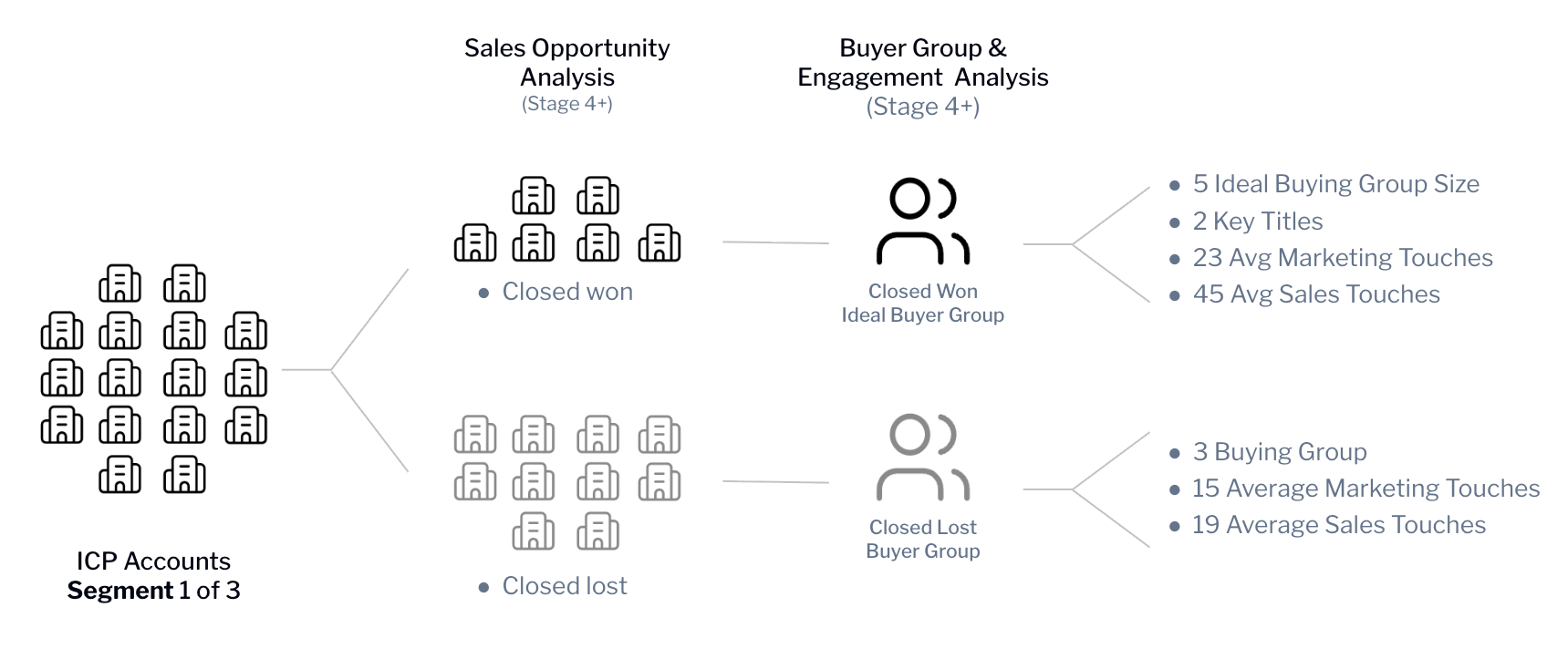
We’re productizing Buyer Group Analytics allowing you to see exactly how engagement correlates with revenue. As shown in our analysis, "Closed Won" deals typically involve a larger buying group (5 people) and significantly higher marketing engagement (23 touches) compared to those that fall through.
AlignICP identifies the specific 'Winning Pattern' for your segments—the exact number of people, the key titles, and the volume of touches required to turn an ICP account into a Closed-Won deal
Operationalizing Forrester’s Marketing Lift
Marketing attribution has been an industry "bogeyman" since my early days at Webtrends. We are finally solving it by operationalizing Forrester’s Marketing Lift model.
Instead of fighting over credit for a first or last touch, AlignICP measures and reports on how marketing:
- Identifies the Ideal Buyer Group: Pinpointing the key titles that drive a win.
- Accelerates Opportunities: Surfacing the engagement levels (avg. 23 touches) required to cross the finish line.
- Proves Contribution: Demonstrating how marketing drives engagement across the entire buying group to create and scale opportunities.
This gives you more than just leads and clicks—it gives you buyer group intelligence. You finally see:
- Which personas matter most
- Which accounts are warming up
- And what marketing actually did to help make that happen
The Inertia of Squishy ICPs and Siloed Segmentation
Too many teams are still working off outdated, overly qualitative ICPs—vague personas and firmographics that feel right but aren’t backed by data.
Segmentation today is often:
- Built in silos (6Sense, Demandbase, Marketo, spreadsheets)
- Owned by individual functions
- Disconnected from actual revenue outcomes
Meanwhile, Marketing is fighting for credibility. Attribution is fuzzy, reporting is fragmented, and AI is flooding teams with even more signals—without any clarity.
All of this leads to more misalignment, more wasted budget, and less confidence in the GTM motion.
CRMs Can’t See the Buying Group—And That Breaks GTM
An additional issue is that CRMs treat Leads, Contacts, Accounts, and Opportunities as separate objects. They weren’t designed to map real-world buying behavior, where multiple stakeholders—across roles, functions, and stages—come together to influence a deal.
This siloed data model makes it impossible to:
- See the full Buying Group
- Track engagement patterns across personas
- Measure true Marketing Lift
- Align Sales and Marketing around real-time buyer behavior
Instead, teams are left guessing. Marketing gets credit for leads, Sales gets blamed for gaps, and no one can actually prove which motions create revenue.
At AlignICP, we’re solving that by bringing structure, visibility, and strategic metrics to the entire buyer group journey.
Strategy vs. Scale: AlignICP + Agentforce
According to Gartner, data quality, unclear ownership, and misaligned processes account for over 80% of AI failures, not model performance. Without a data strategy, you don't have an AI strategy.
Agentforce won’t solve this problem by itself.
Because the bottleneck in modern GTM isn’t “doing more tasks” — it’s knowing which accounts and buying groups are actually worth pursuing.
Salesforce Agentforce = scale.
It gives you autonomous muscle to execute workflows and GTM activities faster.
AlignICP = strategy.
We give you the revenue intelligence that tells those agents where to focus — the right segments, the right accounts, the right buying groups, with the right message.
And this isn’t about replacing your CRM.
AlignICP sits on top of your CRM + billing data to make your GTM system smarter by delivering:
- Message–Market Fit (Win Rate, ACV, Days to Close)
- Product–Market Fit (ARR, NRR, LTV)
- Buyer group analytics that reveal true marketing lift and influence
- A centralized, tiered, dynamic ICP segmentation model every team can activate
Bottom line: Agentforce helps you execute at speed. AlignICP ensures you execute with precision — so automation drives outcomes, not just activity.
Build Your GTM on Signals That Actually Matter
The way forward is clear:
- Start with sales performance data
- Layer in revenue outcomes
- Build segments that reflect who converts, expands, and retains
- Tune them to your goals—faster deals, higher LTV, better NRR
- Activate a centralized, dynamic target account list across every GTM motion
You stop guessing. You start knowing. And every team—from Marketing to Sales to RevOps—executes from the same page.
GTM Is a Team Sport—Let’s Start Acting Like It
The biggest problem in GTM today isn’t tools. It’s leadership. GTM orchestration has no true owner. CEOs often come from sales, product, or finance—not marketing. So segmentation strategy is left fragmented across the org, with no unified framework.
At AlignICP, we’re bringing that leadership layer through intelligence. We help you unify segmentation, clarify strategy, and measure what actually drives revenue—so every team knows where to go, who to reach, and how to win.
And yeah, it’s hard work. But it’s the only way to stop flying blind.
It’s time to rewire your GTM engine around real intelligence.
Let’s talk about how AlignICP can help.
.png)