
Your Target Account List Belongs in Your CRM – But Your CRM Isn’t Enough
Modern B2B SaaS marketing operates in a landscape defined by buying groups, non-linear journeys, and aggressive pipeline targets. Yet most Customer Relationship Management (CRM) systems—Salesforce included—were architected for a different era: one of individual reps working linear deals and tracking simple activities against leads.
The CRM is still the system of record for sales pipeline and deal management. But it is fundamentally ill-equipped for the strategic requirements of modern marketing:
- Deep Ideal Customer Profile (ICP) analysis
- Dynamic, segment-aware Target Account Lists (TALs)
- Complex revenue attribution and Marketing Lift (Forrester) style measurement
This gap helps explain why so many Account-Based Marketing (ABM) motions stall. Pre-opportunity engagement from an account’s buying group gets lost. ICP segments can’t be reliably discovered, measured, or refined. And TALs end up living in spreadsheets or isolated inside MarTech and SalesTech tools—not in a shared, trusted source of truth that GTM teams actually operate from.
Marketing struggles to influence GTM execution because fragmented, inconsistent data hides its true impact on pipeline, LTV, and NRR. Analysts like Forrester have called on B2B marketers to move beyond MQLs and basic “sourced” metrics and instead measure marketing’s real, incremental lift on revenue outcomes.
So if the CRM is necessary but not sufficient, where should your Target Account List live—and what needs to sit on top of it?
How Most Teams Manage TALs Today (And Why It’s a Problem)
Talk to almost any B2B marketing team, and you’ll see a familiar pattern:
- Segments live inside individual MarTech tools (MAP, ABM, paid media) and SalesTech tools (sales engagement, dialers, etc.).
- Each tool uses its own filters, data sources, and enrichment providers.
- “The target account list” exists in multiple slightly different versions, along with a few spreadsheets.
In other words, most ICP segments and TALs are built at the edge of the stack—in execution tools, not in a central system of record or intelligence. <Check out our The Definitive Guide to Data-Driven ICPs to dig in on how to define ICPs>
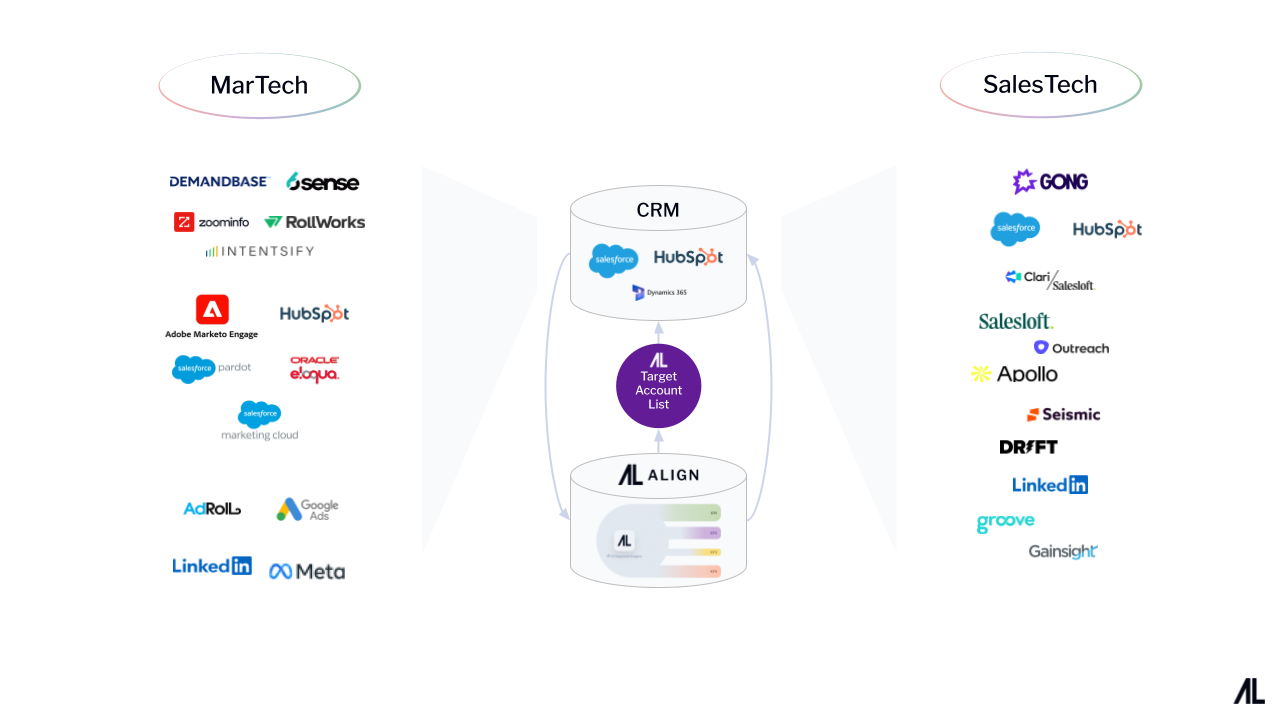
That “edge segmentation” model creates three big problems:
- One-off, guessed-at segments - Segment definitions are often created by “clicking around” in an interface—guessing at industries, titles, and firmographics—without grounding in real performance data like win-rates, ASPs, velocity or NRR and LTV. The result is broad, unfocused segments that feel right but don’t map cleanly to revenue outcomes.
- Inconsistent and conflicting audiences - Because each edge tool builds its own version of “ICP” or “target accounts,” you end up with overlapping but different audiences across email, ads, ABM, and sales engagement. Sales and marketing think they’re aligned, but they’re actually working different lists.
- Broken measurement and no rationalization. When segments are defined ad hoc in edge tools, you can’t centrally compare how “Segment A” in one system performed vs. “Segment A” in another—because they’re not actually the same audience. There’s no single, rationalized TAL to roll metrics up to, so you can’t see which segments truly drive win rate, LTV, and NRR.
This made sense in the early days of ABM and MarTech—those tools were built for marketers; CRMs were not. They offered friendlier interfaces, richer segmentation filters, and tight integration with execution channels.
But today, building segments at the edge is like trying to manage air traffic from inside each plane. You need a control tower.
Why Your Target Account List Belongs in Your CRM
(and Why AlignICP Needs a Slice of That Data)
The first step to fixing the chaos is counterintuitive: bring your Target Account List home. You should centralize and own your ICP segmentation and Target Account List (TAL) in your CRM.
When you do this, you:
- Give sales and marketing a single, aligned, rationalized list of accounts to rally around.
- Avoid duplicate, inconsistent segmentation work across every MarTech and SalesTech tool.
- Make it far easier to measure how ICP vs. non-ICP cohorts perform end-to-end (from opportunity creation through retention and expansion).
But that doesn’t mean your CRM suddenly becomes great at ICP analytics, segmentation, or intent orchestration. It simply means:
- The CRM becomes the owned, centralized repository of your TAL and ICP tags.
- The heavy lifting—analysis, exploration, and optimization—moves into a dedicated intelligence layer that feeds the CRM.
That’s where AlignICP comes in.
Extract the Right CRM Data, Then Make It Smarter
Instead of copying your entire CRM into yet another warehouse, AlignICP extracts only the critical subset of CRM data needed to build real GTM intelligence:
- Accounts, contacts, leads and opportunities
- Key revenue and product SKU data
- Core fields tied to ICP, performance, and lifecycle
Once AlignICP has that curated slice, it:
- Augments and cleans the data
- Normalizes company, industry, and geo fields
- Generate “fit” metrics and resolve messy hierarchies
- Enriches with additional context where needed
- Applies shared taxonomies
- Standardizes how you define industries, segments, tiers, and motions
- Creates a consistent language that GTM teams can use across tools and reports
- Enables ICP segment exploration and discovery
- Let's you experiment with different cohort definitions without breaking CRM.
- Surfaces high-MMF / high-PMF segments based on real sales and revenue metrics
- Shows how different slices actually perform on win rate, ASP, days-to-close, LTV, NRR, and ARR
- Builds and manages a unified, rationalized TAL
- Maps your best-performing segments to prospects
- Produces a deduped, prioritized Target Account List with segment and tier context
- Syncs that TAL and tags back into CRM as the single source of truth
- Layers in intent signals to expose who’s in market
- Combines ICP fit with third-party and first-party intent data
- Flags which accounts from your TAL are surg, on which topics, and at what intensity.
- Turns “this is a good-fit account” into “this good-fit account is in market now for this problem.”
From there, every MarTech and SalesTech tool can execute from the same CRM-centered TAL + ICP tags, while AlignICP continues to refine segments and prioritize accounts behind the scenes.
So the mental model becomes:
- CRM = system of record and home of the TAL
- AlignICP = Market & Account Intelligence System that extracts key CRM data, makes it smarter, and feeds it back.
You keep your TAL where GTM teams live every day (the CRM), and you let AlignICP do the hard work of augmentation, taxonomy, ICP discovery, and intent-driven prioritization around it.
Make It Self-Serve With a GPT-Style UI
Even the best Market & Account Intelligence System fails if only data and RevOps teams can actually use it.
That’s where a Generative AI / Large Language Model (LLM)–powered, GPT-style interface comes in. Instead of requiring GTM teams to learn schemas or BI tools, you give them a conversational UI on top of your intelligence layer.
Examples:
- ABM director: “Give me 40 Tier 1 accounts in our North America Mid-Market Software ICP segment with strong intent on ‘security’ for a one-to-few campaign next quarter.”
- Field marketer: Show me senior economic buyers and champions in high-importance buying groups within 30 miles of Chicago from our TAL so that I can invite them to an executive dinner.
- Sales leader: For my region, rank accounts by ICP fit, MMF/PMF, and recent engagement. Highlight the top 25 accounts we should focus on next quarter for our QBR.
The GPT/LLM layer:
- Translates natural language into precise queries on your Market & Account Intelligence dataset.
- Respects role-based permissions and governance.
- Returns accounts, segments, and context that teams can push directly into campaigns, sequences, or plans.
No SQL. No “can you pull me a list?” tickets. Just GTM teams exploring and acting on the same central source of truth.
The Bottom Line
Your Target Account List shouldn’t live as a dozen slightly different versions across ABM tools, SalesTech tools, spreadsheets, and one-off reports—each with their own guessed-at, too-broad segments.
It should live:
- Centrally in your CRM as the source of truth for sales and marketing.
- Powered by a Market & Account Intelligence System that discovers data-driven ICP segments, models buying groups, measures Marketing Lift, and manages your TAL.
- Exposed through a GPT-style UI so every GTM stakeholder can use it in their day-to-day work.
That’s the stack that turns “knowing your ICP” from a theoretical exercise into a live, operational GTM advantage.
If you want to see what that looks like in practice, AlignICP solves this problem end-to-end. Like in practice, AlignICP was built to solve this problem precisely.
Contact Us to learn more about how we’re helping B2B teams centralize their TAL, rationalize segments, and make GTM intelligence self-serve.
.png)