

Ghost Pipeline: Why your CRM metrics and your AEs are telling you completely different stories!
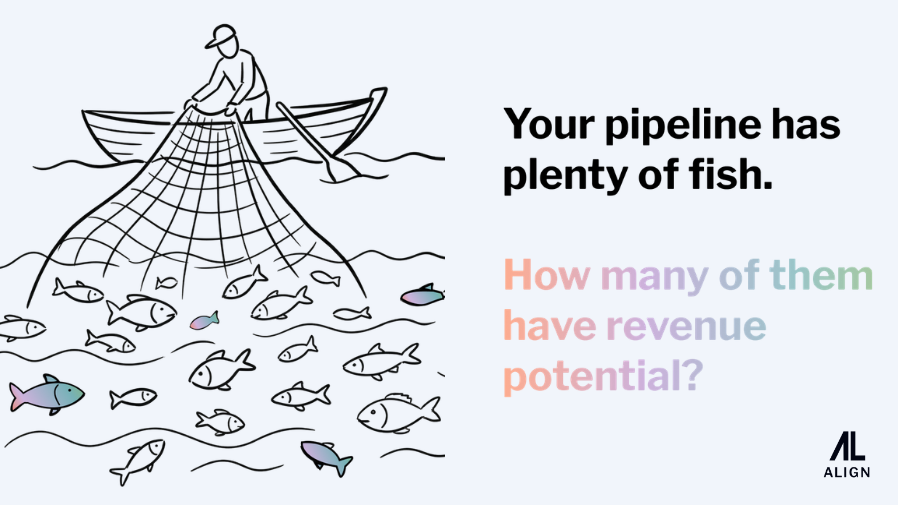
What is Ghost Pipeline?
Ghost Pipeline is the gap between what your CRM reports as qualified and what your revenue data says actually closes. You know them, they are opportunities that give you the coverage that you need to provide a confident forecast, but keep you up at night because towards the middle of the quarter seem to always push. Ultimately, leaving you high and dry on the forecast.
It's not a data quality problem. The CRM is reporting accurately — activities completed, stages advanced, meetings booked. The problem is that none of that activity tells you whether the opportunity matches the profile of the accounts and the use cases correlated with closed-won history.
Ghost Pipeline fills up with opportunities with accounts that match your firmographic criteria. That responds to your outreach. That shows intent signals. That advances through your funnel. These are accounts that engage — but that have never, in your company's actual history, converted to revenue at any meaningful rate.
The CRM doesn't know the difference. It stores what happened. It has no opinion about what makes a forecastable opportunity. That's not a flaw — it's simply not what it was designed to do.
Where the targeting assumption breaks down
Most B2B revenue teams build their total addressable list from two inputs: firmographic filters and third-party intent signals.
Firmographic filters tell you who looks like a customer — company size, industry, tech stack, ARR range. Intent signals tell you who is paying attention — downloading content, visiting your pricing page, researching your category.
Neither tells you which accounts, based on your own data, have historically closed, expanded, and retained at meaningful rates.
The result is a list built on market assumptions that have never been tested against your revenue history. That list gets operationalised into the CRM, the ABM platform, and the outbound sequences. Every tool in the GTM stack inherits the same targeting logic — blind to whether any of it is grounded in what your company actually closes.
AIactivation doesn't fix a targeting assumption problem. It simply scales it.
When MQL volume is up but MQL-to-SQL conversion isn't moving, when AEs are booking meetings but deals are stalling at proposal, when pipeline coverage looks healthy and win rate keeps declining — the problem isn't the people or the tools; it's what the tools are being pointed at.
What Ghost Pipeline actually costs
The visible cost is a suboptimal win rate. But Ghost Pipeline carries two costs that don't appear on the standard dashboard.
The first is AE capacity. When AEs work accounts that aren't a fit, they discover that through the sales process — weeks of discovery sessions, follow-up sequences, proposals, and pipeline reviews — that opportunities were never going to close. At a $200,000 base salary, that's a significant fraction of a person's year spent on qualification that should have happened before the account entered the funnel.
The second is forecast integrity. When the pipeline is full of poor fit opportunities which have not been tested against win rates, the sales leader is left holding a bag and the Ghost pipeline disappears. Soon the CRO further weighting the pipeline, and the required coverage goes from 3X to 5X. The CFO discounts the forecast. The board applies its own. Nobody trusts the number — but nobody can explain exactly why it keeps missing, because the problem isn't visible in the same system that created it.
Over time, this compounds. The organization spends millions of dollars attending events and running programs to generate pipeline. Over time, the sales teams learn not to trust the leads, causing them to cherry-pick. Now you have a broken targeting layer and a fractured relationship between Sales and Marketing, neither of which is fixable with a revised playbook or a new comp structure.
Pipeline coverage looks healthy. Win rate keeps declining. That's almost always a revenue context problem upstream — not a sales execution problem downstream.
What the fix actually requires
Fixing Ghost Pipeline doesn't require replacing your ABM platform or your intent data provider. The tools aren't the problem — they're doing exactly what they were designed to do.
What's missing is a validated intelligence layer between your revenue data and your targeting decisions. One that answers a different question: not 'who looks like a customer' — but 'which accounts are buying against use cases that share characteristics of our most profitable customer segments.
That question can only be answered by analyzing your own revenue data, it's not something third-party signals can answer. Not even firmographic models can answer it. The answer lives in your win/loss patterns, your expansion behavior, and your custom retention rates — data most companies have never connected systematically to their targeting logic.
AlignICP Qualified Accounts™ are built from that intelligence. Every account is validated against revenue-backed signals derived from a segment’s closed-won history, expansion patterns, and retention data. Accounts that pass are Qualified. The rest are exposed — so the team stops investing where the data says not to.
The GTM stack runs exactly as it was designed. It finally has a map.
Frequently asked questions
What is Ghost Pipeline in B2B sales?
Ghost Pipeline are opportunities that look qualified by standard CRM metrics — stage advancement, activity levels, lead score — but don't match the profile of accounts that historically convert to revenue. It occurs when a company's total addressable list is built on firmographic filters and intent signals rather than validated revenue intelligence from its own closed-won data.
Why doesn't my CRM identify Ghost Pipeline?
CRMs are designed to store and organise sales activity. They record what happened — they were never designed to evaluate whether an account has the characteristics that predict a close-won. Identifying Ghost Pipeline requires an intelligence layer that validates accounts against actual revenue performance data, not against activity data.
Is Ghost Pipeline a sales execution problem or a targeting problem?
Almost always a targeting problem. The most common mistake is attributing poor close rates to sales execution — adjusting the playbook, adding coaching, revising discovery frameworks. These address the symptom. The root cause is that the accounts the team is working on were never validated against revenue data before they entered the funnel.
How do you know if your pipeline contains mostly Ghost Pipeline?
Pull your last 24 months of closed-won deals and identify the 10 accounts with the highest lifetime value. Write down 5 characteristics they share-pay special attention to the use cases that drove the conversion. Then look at your current pipeline and ask how many active accounts match those characteristics. If the answer is 'not many' or 'I can't tell' — you're looking at Ghost Pipeline.
What's the difference between Ghost Pipeline and bad leads?
Ghost Pipeline is structural, not situational. Bad leads are an occasional failure; a campaign underperformed, the wrong person responded. Ghost Pipeline is systematic: the entire targeting layer is built on assumptions that were never tested against revenue data. It produces consistently low-fit accounts regardless of the channel, the campaign, or the quarter.
The pipeline problem most revenue teams aren't solving
Ghost Pipeline is solvable, but only once the root cause is clear. The problem isn't in the tools. It isn't in the team. It's in the intelligence layer those tools are running on.
Your GTM stack was built to activate, automate, and engage. It was never built to validate. That's the revenue context problem.
For a deeper look at how the GTM stack creates bad pipeline and what the intelligence layer looks like when it's built correctly.
.png)
.png)